
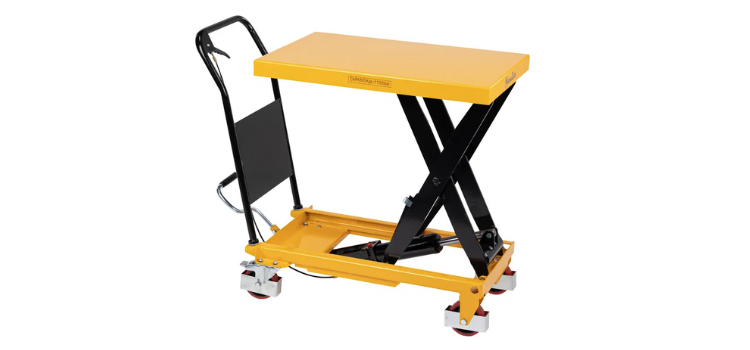
A scissor lift table is a mechanical platform that raises or lowers heavy items using a crisscross (scissor-style) mechanism. Powered either manually (hydraulic foot pump) or electrically, they enhance safety and productivity in industries such as:
- manufacturing
- assembly
- warehousing
- logistics
Why use a scissor lift table?
When it comes to handling heavy loads in fast-paced work environments, efficiency and safety are crucial. Scissor lift tables offer a simple yet powerful solution to everyday material handling challenges. By elevating goods to an ergonomic working height, they reduce physical strain, streamline workflows and help create safer, more productive spaces. Here are the key benefits that make scissor lift tables a smart investment for your business:
✅ Improves ergonomics
✅ Reduces injury risk
✅ Streamlines lifting tasks
Single vs double scissor lift tables: what’s the difference?
| Feature | Single scissor lift table | Double scissor lift table |
| Design | One set of scissor arms | Two sets of scissor arms stacked vertically |
| Lift height | Moderate lift height (typically up to 1m) | Extended lift height (can reach 1.5m–2m or more) |
| Stability | Very stable for lower elevations | Stable at greater heights but may require larger base |
| Footprint | More compact | May require slightly more space due to vertical mechanism |
| Best for | Workbenches, packing stations, low-level lifting | Loading docks, mezzanine access, high-reach applications |
| Common power options | Manual (hydraulic) or electric | Usually electric due to greater lifting demand |
Which should you choose?
- Choose a single scissor lift if you need:
- simple height adjustment up to 1 metre
- lower cost and smaller footprint
- a mobile or bench-top lifting solution
- Choose a double scissor lift if you need:
- extra lift height for stacking or accessing higher platforms
- a solution for vertical travel without needing a pit or ramp
- heavy-duty performance in more industrial applications
Key features to consider
✅ Load capacity — match to your heaviest items
✅ Lift height — ensure vertical range suits your task
✅ Table size — fit to the footprint of your typical loads
✅ Mobility — choose mobile or fixed based on workflow
✅ Power source — manual (low use) vs electric (heavy or frequent use)
Safety tips for using scissor lift tables
- Don’t exceed weight limits
- Ensure stable placement before use
- Use brakes on mobile models
- Never reach under a raised platform without props
- Train staff thoroughly
Conclusion: lift smarter, work safer
Investing in the right scissor lift table isn’t just about lifting loads — it’s about improving workplace efficiency, safety and overall productivity. Whether you need a manual, electric or mobile solution, Rapid Racking offers high-quality options backed by expert advice and fast delivery. With the right lift table, your team can work smarter, reduce physical strain and create a safer, more efficient workspace.
Ready to make lifting easier?
👉 Explore our full range or speak to our team — we’re here to help you choose the perfect fit for your operation.